You Can’t Do It All

Recently, over a weekend brunch with my mum (I’m a middle-class blonde girl with an Instagram account, what do you expect?), we got onto the subject of what I was doing This Time Last Year, a conversation we seem to have every three months.

 I remember September 2016 very vaguely. My mum remembered that I was dreading going back to Warwick for a number of reasons, and I can definitely recall the knot I had in my stomach when I unlocked the door of our student house on my first day back. On the other hand, I remember being filled with determination that I was going to do everything I’d wanted to at university that year. 

Over the summer I’d read Marina Keegan’s ‘The Opposite of Loneliness’ and was half impressed, half intimidated by everything she’d achieved. She wrote and acted in plays, attended writing classes, was the president of the Yale College Democrats, knew how to sail, dedicated three hours a day to writing, got a job at The New Yorker, had a boyfriend. What struck me the most about this was that she had something to leave behind when she tragically died a few days after graduating. 

This sent me into a panic. I’d thought about what I’d done so far at university: ‘Well, I’ve sub-edited and written articles for the university paper…I wrote some pretty good essays and…and…’ That was it really. 

 Before coming to Warwick, I had a very idealised picture of what my university career would be like. I’d passionately hated my secondary school experience and would do anything to avoid going to school. Sick of being ‘the quiet one’ from Years 7-13, 15-year-old me had firmly set her sights on studying English at university. The utopia-like vision I had of university life got me through the last three years of school, and, without it, I definitely wouldn’t have done as well as I had. The idea of university was special to me because it was meant to be a place where I could be the person I wasn’t allowed to be in my hometown, somewhere I never really felt ’at home’ in the end. 

 So, when I lugged my suitcase into my tiny Rootes room in 2014, it’s safe to say I had pretty big expectations. I was, of course, going to graduate with a First (something I somehow achieved, though I’m still not sure how). I was going to love every single book I read, and edit the student paper, and act in all the student productions, and go to the Fringe, and get back into dance, and have the best social life, and write award-winning novels in my spare time. I managed to do about one of these things fully and a few of the other things a little bit. But, let’s face it, I was never going to love Sir Gawain and The Green Knight, no matter how hard I tried. 

 The truth is, you can’t do everything. I was lucky enough to become an Editor on my student paper, and helped to direct a student production in my third year, but I barely had time to sleep and eat, let alone do any of the other things. We can’t all be Marina Keegan, and that’s fine. I spent a while after graduating kicking myself for not having done more at university. But there aren’t enough hours in the day.

 I’m proud of everything I achieved at university, even if I didn’t get the experience I expected. So, when my mum asked if I’d enjoyed myself, I said yes, but I wish I had another three years. 

Post-Grad Blues

I read a wonderful article in the Metro recently about post-graduate depression, a subject that has been on my mind quite a lot recently. A few things have contributed to the nostalgia I’ve been feeling, from seeing younger students move into their campus accommodation, to reading about the university experiences of celebrities in their biographies.

DISCLAIMER: I’m lucky enough to not suffer from depression, but the post-uni blues have been hitting me hard this past week. A year ago, I would have been stocking up on things to take to my student house, frantically trying to ‘get ahead’ with reading (i.e. reading the first ten pages of one set text), and spending as much time as I could with the family and in the city that I love.

I keep finding myself lapsing into the old, familiar feeling of starting a new educational year. I think that’s pretty fair – I have, after all, spent seventeen Septembers preparing myself for school. Needless to say then, it’s been a bit of a shock to my system not to have  to buy new stationary, uniform, or overpriced books.

Leaving university feels the same as those books that abruptly end. You get to the final page and think, “What? That’s it?”, just as things were getting good, and the shock that there are no more pages leaves you feeling disappointed. As corny as tenuous as this metaphor is, it pretty much sums up how I – and probably many other graduates – currently feel.

I spent most of last night sadly scrolling through photos of the past three years on Facebook, thinking about how much I’ve changed and how I wish I could do it all over again – not because I regret the way I did university, but because I loved it so much. I had huge expectations for university life, and three years just didn’t give me enough time to do everything I wanted.

Of course, I may be looking back with rose tinted glasses. As much as I loved university, I spent at least 30% of the time crying down the phone and screaming into pillows, whilst the other 70% consisted of house parties, late night talks, and wonderful societies.

Towards the end of my final year, on the way back from a walk, I boldly told my friend  that I was going to forge my own identity after university by doing exactly what I wanted to do, ‘because that’s the best way to be yourself’. I don’t think I was wrong – doing what you want to do instead of managing your actions through fear of judgement is great. But I’m annoyed that I didn’t see how far I had come in those three years. I wouldn’t have admitted that I was shy when I started university, but I was. University managed to change that, even if only slightly. I went from saying about three sentences in conversations to actively seeking out new people to talk to. I started going to the parties I’d avoided throughout secondary school. For once, I started to relax and be myself – even if I felt I wasn’t wholly myself yet.

For some people, university really is the best years of you life, so it’s only natural to feel the post-grad blues when you leave. I just wish I’d been a little more prepared.

Learning to Fail

After checking my bank balance online, I decided it was time to take a rain check on purchasing the £40 Dress of Dreams™ I’d been fawning over for the past week.

After a month of returning home from university and turning down a job offer in China, I was slowly coming to terms with the fact that I had no current income. Six months ago, I wouldn’t have batted an eyelid about handing over forty of my finest English pounds to Zara – but six months ago, the lovely people of Student Finance Wales were there to help. The Dress of Dreams™ would have to wait.

This year, I’ve decided to take a gap year to earn some money before doing a masters. I was accepted to the first position I applied to, but ended up turning it down – my parents found the change of their only child being 160 miles away to 5000 miles across the world a little difficult. This decision all seemed well and good: I’d been able to get a 1:1, nab some freelancing opportunities, and spend some much needed time with friends and family instead of faffing around with documentation and language apps. “I’ll just get another job”, I thought. Oh how naive I was.

People weren’t lying when they said the job opportunities were all in the big cities. I’ve been scouring job sites on the daily in a desperate attempt to find a job that actually pays. For all the criticisms launched at millenials, nobody can fault us for the amount of unpaid work we do. Unfortunately, my hometown has never seemed smaller, and the only jobs available are in recruitment or serving at the new restaurants that have recently opened.

I’d tried to apply for jobs in marketing, grad schemes, or at my local university to no avail. After another post-interview rejection for a position that would have given me the opportunity to live in Italy for a year, I felt completely knocked, resulting in a public cry in the middle of Tesco. “I’m failing at everything“, I whined down the phone to my parents. If you think I was being dramatic and entitled, you would be correct. This was only the third position I’d applied to. Ever. But hear me out.

A few months ago, I wrote an article for my student paper about the unhealthily competitive atmosphere at my university, and the response it garnered felt like double-edged sword. I was overwhelmed by how many people related to the article, sharing it on their own social media accounts in agreement that the competition at Warwick had gone too far. Part of me felt glad that I’d said what a lot of people were thinking. On the other hand, if so many people felt as down about the competitive nature of university as I did, then something must be very wrong.

With the pressure to do well in all areas of life (not exactly helped by the brag-fest that is social media), it’s no wonder young people feel like failures when they face rejection. Whereas getting a good degree may have been the main pressure for students before, the need to find the perfect grad job/work experience/internship seems to have taken precedence.

Before the job rejections, I’d felt genuinely happy about my 1:1. It was a goal I’d set myself from the outset and one that I’d gone above and beyond to achieve. But that happiness and pride seemed to disappear in a flash once I returned home. My friends  had somehow landed flashy grad jobs, and well-meaning but nosy distant relatives constantly interrogated me with the question all unemployed graduates dread: “Have you got a job yet?” It’s a question I’m asked nearly every day and every time I answer “No”, I can’t help feeling that, at the ripe old age of 21, I’ve failed at life.

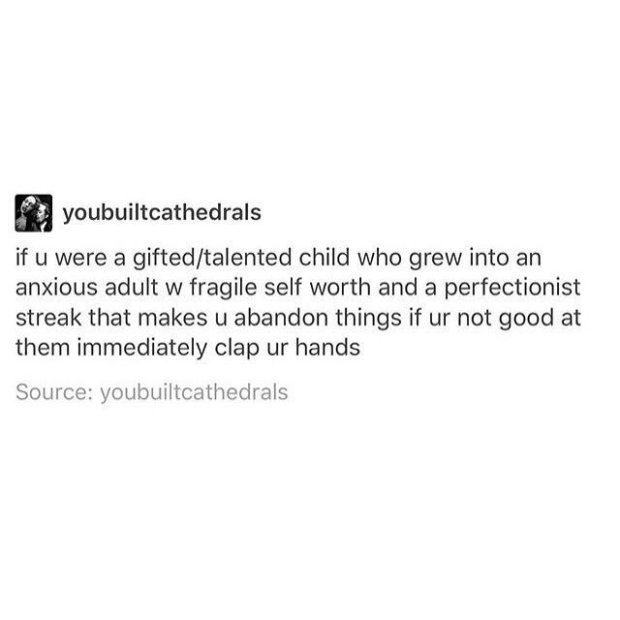
The next few months are probably going to be the hardest thing I’ve done. Maybe even harder than GCSE maths. And it’s all because, not to brag here, but I’ve never really failed before. While scrolling through Twitter on a clearly productive streak (…) I stumbled across a tweet that made me genuinely laugh out loud and give myself a reality check:

C9krZUQXkAUGHEj.jpg-large

It made me realise how stupid I was being. Like most ‘snowflake’, millennial graduates, I’d been told I was clever and capable my entire life. I got the highest grades, was put into the Oxbridge group in Sixth Form, and accepted into my dream university. Of course, this only happened with a ridiculous amount of hard work and hours pouring over textbooks, but it convinced me that if I worked hard, I could get exactly what I wanted. This, I quickly realised, is not the case, hence my Tesco breakdown.

So I’ve decided to use this year as a time to learn something new – cue swelling, inspirational music. Namely, how to fail. I’m sure plenty more rejections are coming my way, but that doesn’t mean my future is void of opportunities. I may not have skipped straight into a grad job, but I’ve managed to gain things I never thought I would. I’m starting a new (temporary) position at Mind, something I’ve wanted to do for ages. I’m about to get paid for my first published article and have just sent off another. In a few months, I’ll be spending a fortnight at The Times.

I may not be raking in the cash just yet, and the Dress of Dreams™ might have to wait for now, but it doesn’t mean I have nothing to look forward to. It certainly doesn’t warrant a public breakdown in a supermarket. What I’ve quickly come to realise, is that failing is ok. You don’t have to hide it, or construct elaborate lies to disguise it. Those who you really want in your life will support you, instead of gloating over your unemployment. And as for the other people? Screw them.