You Can’t Do It All

Recently, over a weekend brunch with my mum (I’m a middle-class blonde girl with an Instagram account, what do you expect?), we got onto the subject of what I was doing This Time Last Year, a conversation we seem to have every three months.

 I remember September 2016 very vaguely. My mum remembered that I was dreading going back to Warwick for a number of reasons, and I can definitely recall the knot I had in my stomach when I unlocked the door of our student house on my first day back. On the other hand, I remember being filled with determination that I was going to do everything I’d wanted to at university that year. 

Over the summer I’d read Marina Keegan’s ‘The Opposite of Loneliness’ and was half impressed, half intimidated by everything she’d achieved. She wrote and acted in plays, attended writing classes, was the president of the Yale College Democrats, knew how to sail, dedicated three hours a day to writing, got a job at The New Yorker, had a boyfriend. What struck me the most about this was that she had something to leave behind when she tragically died a few days after graduating. 

This sent me into a panic. I’d thought about what I’d done so far at university: ‘Well, I’ve sub-edited and written articles for the university paper…I wrote some pretty good essays and…and…’ That was it really. 

 Before coming to Warwick, I had a very idealised picture of what my university career would be like. I’d passionately hated my secondary school experience and would do anything to avoid going to school. Sick of being ‘the quiet one’ from Years 7-13, 15-year-old me had firmly set her sights on studying English at university. The utopia-like vision I had of university life got me through the last three years of school, and, without it, I definitely wouldn’t have done as well as I had. The idea of university was special to me because it was meant to be a place where I could be the person I wasn’t allowed to be in my hometown, somewhere I never really felt ’at home’ in the end. 

 So, when I lugged my suitcase into my tiny Rootes room in 2014, it’s safe to say I had pretty big expectations. I was, of course, going to graduate with a First (something I somehow achieved, though I’m still not sure how). I was going to love every single book I read, and edit the student paper, and act in all the student productions, and go to the Fringe, and get back into dance, and have the best social life, and write award-winning novels in my spare time. I managed to do about one of these things fully and a few of the other things a little bit. But, let’s face it, I was never going to love Sir Gawain and The Green Knight, no matter how hard I tried. 

 The truth is, you can’t do everything. I was lucky enough to become an Editor on my student paper, and helped to direct a student production in my third year, but I barely had time to sleep and eat, let alone do any of the other things. We can’t all be Marina Keegan, and that’s fine. I spent a while after graduating kicking myself for not having done more at university. But there aren’t enough hours in the day.

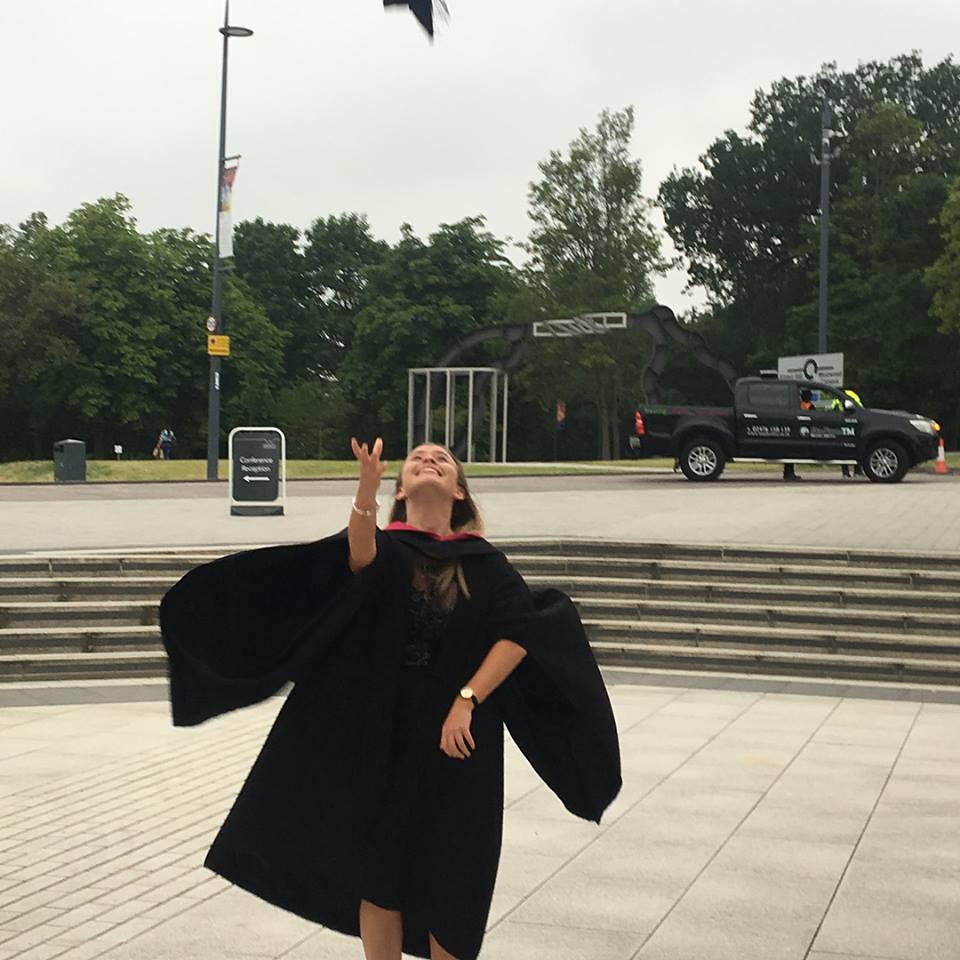
 I’m proud of everything I achieved at university, even if I didn’t get the experience I expected. So, when my mum asked if I’d enjoyed myself, I said yes, but I wish I had another three years. 

A Response to Newsnight

A couple of nights ago, Newsnight aired a feature discussing the Welsh language and government plans to change the way it is promoted. With no fluent Welsh speakers on the panel and the history of the language being completely overlooked, Twitter exploded with complaints. 

Ultimately, Newsnight apologised last night and ended their program with a performance from Welsh band, Yr Eira, at the Eisteddfod – a great way to give the language and culture the recognition it deserves.

Welsh is my second language. I was taught it from the moment I started school and happily took the option to study it at GCSE and A Level. I guess you could say I am “keen on Welsh”, like the other people who speak the language, or any language at all for that matter.

The feature kicked off with some facts and figures about the Welsh language, showing an ultimate decrease in Welsh speakers from 50% in 1901 to only 11% of fluent Welsh speakers today. No wonder the English perceive Welsh to be a “dying” language, one that is slowly being replaced by English and fading into obscurity. What the program didn’t bother mentioning, however, was why Welsh started to fade into obscurity, a story of oppression and colonisation that I was taught from the age of six.

You see, Welsh people didn’t just decide to stop speaking Welsh one day because English was superior, or gave them better job prospects, or whatever. The mid nineteenth century was a particularly turbulent time for Wales, with many uprisings breaking out across the country (see The Rebecca Riots and particularly the injustice of the Merthyr Rising), the ‘lawlessness’ of which was put down to the existence of the Welsh language.

A parliamentary report in 1847 – which became known as the Treachery of the Blue Books – ultimately felt that the Welsh language was a drawback for the moral development of the Welsh people, which, of course, could only be solved with the introduction of English in schools. This saw the beginning of the Welsh Not, a system that forced Welsh speaking children to speak English or face being punished at the end of the school day. Similar systems were put in place all over the world to ‘promote’ English over other languages.

People did eventually stop speaking Welsh – it became associated with the working classes and many Welsh speaking parents saw it as a drawback for the futures of their children – including Dylan Thomas’s Welsh speaking parents who sent their son to elocution lessons to mask his accent.

This history was completely overlooked by Newsnight’s feature, which seemed to present the language as some kind of time-wasting “hobby” enjoyed by Nationalists determined to see the country fail and cost the tax payer hundreds. They also didn’t consider that people who are “keen on Welsh” are equally keen on preventing the death of the heritage.

The main criticism launched at the feature was the lack of fluent Welsh speakers on the panel. It was great to see Ruth Dawson, a second language Welsh speaker like myself, showing passion about preserving a language she herself didn’t speak fluently. For me, it showed that you didn’t need to speak a language fluently to understand the importance of its heritage.

But the lack of fluent Welsh speakers only seemed to suggest that they were nearly extinct, certainly not helped by the figures shown at the beginning of the feature or the complete ignorance of the history behind the language. I counted the number of first-language Welsh speakers I know personally – there were more than twenty in my circle of friends. There was no excuse as to why a first-language Welsh speaker was absent from the panel.

Even Derek Walcott, a Caribbean poet whose education consisted of having to read English literature as opposed to learning about his own culture, touched on the eradication of the Welsh language in his poetry:

Those white flecks cropping the ridges of Snowdon
will thicken their fleece and come wintering down
through the gap between alliterative hills,
through the caesura that let in the Legions,
past the dark, disfigured mouths of the chapels,
till a white silence comes to green-throated Wales

(taken from ‘Wales’)

It’s not difficult to see Walcott’s point. His images of suffocation, strangulation, and silencing, reflect the negative attitude towards one of the oldest languages in Europe, a language that predates English and continues to be spoken today, against all odds. Saving the Welsh language isn’t just a “hobby”. It’s an attempt to preserve a culture and history after the events of 1282, 1535-1542, 1831, 1847, 1911, and as recently as 1993, 2010, and 2011.