You Can’t Do It All

Recently, over a weekend brunch with my mum (I’m a middle-class blonde girl with an Instagram account, what do you expect?), we got onto the subject of what I was doing This Time Last Year, a conversation we seem to have every three months.

 I remember September 2016 very vaguely. My mum remembered that I was dreading going back to Warwick for a number of reasons, and I can definitely recall the knot I had in my stomach when I unlocked the door of our student house on my first day back. On the other hand, I remember being filled with determination that I was going to do everything I’d wanted to at university that year. 

Over the summer I’d read Marina Keegan’s ‘The Opposite of Loneliness’ and was half impressed, half intimidated by everything she’d achieved. She wrote and acted in plays, attended writing classes, was the president of the Yale College Democrats, knew how to sail, dedicated three hours a day to writing, got a job at The New Yorker, had a boyfriend. What struck me the most about this was that she had something to leave behind when she tragically died a few days after graduating. 

This sent me into a panic. I’d thought about what I’d done so far at university: ‘Well, I’ve sub-edited and written articles for the university paper…I wrote some pretty good essays and…and…’ That was it really. 

 Before coming to Warwick, I had a very idealised picture of what my university career would be like. I’d passionately hated my secondary school experience and would do anything to avoid going to school. Sick of being ‘the quiet one’ from Years 7-13, 15-year-old me had firmly set her sights on studying English at university. The utopia-like vision I had of university life got me through the last three years of school, and, without it, I definitely wouldn’t have done as well as I had. The idea of university was special to me because it was meant to be a place where I could be the person I wasn’t allowed to be in my hometown, somewhere I never really felt ’at home’ in the end. 

 So, when I lugged my suitcase into my tiny Rootes room in 2014, it’s safe to say I had pretty big expectations. I was, of course, going to graduate with a First (something I somehow achieved, though I’m still not sure how). I was going to love every single book I read, and edit the student paper, and act in all the student productions, and go to the Fringe, and get back into dance, and have the best social life, and write award-winning novels in my spare time. I managed to do about one of these things fully and a few of the other things a little bit. But, let’s face it, I was never going to love Sir Gawain and The Green Knight, no matter how hard I tried. 

 The truth is, you can’t do everything. I was lucky enough to become an Editor on my student paper, and helped to direct a student production in my third year, but I barely had time to sleep and eat, let alone do any of the other things. We can’t all be Marina Keegan, and that’s fine. I spent a while after graduating kicking myself for not having done more at university. But there aren’t enough hours in the day.

 I’m proud of everything I achieved at university, even if I didn’t get the experience I expected. So, when my mum asked if I’d enjoyed myself, I said yes, but I wish I had another three years. 

Post-Grad Blues

I read a wonderful article in the Metro recently about post-graduate depression, a subject that has been on my mind quite a lot recently. A few things have contributed to the nostalgia I’ve been feeling, from seeing younger students move into their campus accommodation, to reading about the university experiences of celebrities in their biographies.

DISCLAIMER: I’m lucky enough to not suffer from depression, but the post-uni blues have been hitting me hard this past week. A year ago, I would have been stocking up on things to take to my student house, frantically trying to ‘get ahead’ with reading (i.e. reading the first ten pages of one set text), and spending as much time as I could with the family and in the city that I love.

I keep finding myself lapsing into the old, familiar feeling of starting a new educational year. I think that’s pretty fair – I have, after all, spent seventeen Septembers preparing myself for school. Needless to say then, it’s been a bit of a shock to my system not to have  to buy new stationary, uniform, or overpriced books.

Leaving university feels the same as those books that abruptly end. You get to the final page and think, “What? That’s it?”, just as things were getting good, and the shock that there are no more pages leaves you feeling disappointed. As corny as tenuous as this metaphor is, it pretty much sums up how I – and probably many other graduates – currently feel.

I spent most of last night sadly scrolling through photos of the past three years on Facebook, thinking about how much I’ve changed and how I wish I could do it all over again – not because I regret the way I did university, but because I loved it so much. I had huge expectations for university life, and three years just didn’t give me enough time to do everything I wanted.

Of course, I may be looking back with rose tinted glasses. As much as I loved university, I spent at least 30% of the time crying down the phone and screaming into pillows, whilst the other 70% consisted of house parties, late night talks, and wonderful societies.

Towards the end of my final year, on the way back from a walk, I boldly told my friend  that I was going to forge my own identity after university by doing exactly what I wanted to do, ‘because that’s the best way to be yourself’. I don’t think I was wrong – doing what you want to do instead of managing your actions through fear of judgement is great. But I’m annoyed that I didn’t see how far I had come in those three years. I wouldn’t have admitted that I was shy when I started university, but I was. University managed to change that, even if only slightly. I went from saying about three sentences in conversations to actively seeking out new people to talk to. I started going to the parties I’d avoided throughout secondary school. For once, I started to relax and be myself – even if I felt I wasn’t wholly myself yet.

For some people, university really is the best years of you life, so it’s only natural to feel the post-grad blues when you leave. I just wish I’d been a little more prepared.

A Response to Newsnight

A couple of nights ago, Newsnight aired a feature discussing the Welsh language and government plans to change the way it is promoted. With no fluent Welsh speakers on the panel and the history of the language being completely overlooked, Twitter exploded with complaints. 

Ultimately, Newsnight apologised last night and ended their program with a performance from Welsh band, Yr Eira, at the Eisteddfod – a great way to give the language and culture the recognition it deserves.

Welsh is my second language. I was taught it from the moment I started school and happily took the option to study it at GCSE and A Level. I guess you could say I am “keen on Welsh”, like the other people who speak the language, or any language at all for that matter.

The feature kicked off with some facts and figures about the Welsh language, showing an ultimate decrease in Welsh speakers from 50% in 1901 to only 11% of fluent Welsh speakers today. No wonder the English perceive Welsh to be a “dying” language, one that is slowly being replaced by English and fading into obscurity. What the program didn’t bother mentioning, however, was why Welsh started to fade into obscurity, a story of oppression and colonisation that I was taught from the age of six.

You see, Welsh people didn’t just decide to stop speaking Welsh one day because English was superior, or gave them better job prospects, or whatever. The mid nineteenth century was a particularly turbulent time for Wales, with many uprisings breaking out across the country (see The Rebecca Riots and particularly the injustice of the Merthyr Rising), the ‘lawlessness’ of which was put down to the existence of the Welsh language.

A parliamentary report in 1847 – which became known as the Treachery of the Blue Books – ultimately felt that the Welsh language was a drawback for the moral development of the Welsh people, which, of course, could only be solved with the introduction of English in schools. This saw the beginning of the Welsh Not, a system that forced Welsh speaking children to speak English or face being punished at the end of the school day. Similar systems were put in place all over the world to ‘promote’ English over other languages.

People did eventually stop speaking Welsh – it became associated with the working classes and many Welsh speaking parents saw it as a drawback for the futures of their children – including Dylan Thomas’s Welsh speaking parents who sent their son to elocution lessons to mask his accent.

This history was completely overlooked by Newsnight’s feature, which seemed to present the language as some kind of time-wasting “hobby” enjoyed by Nationalists determined to see the country fail and cost the tax payer hundreds. They also didn’t consider that people who are “keen on Welsh” are equally keen on preventing the death of the heritage.

The main criticism launched at the feature was the lack of fluent Welsh speakers on the panel. It was great to see Ruth Dawson, a second language Welsh speaker like myself, showing passion about preserving a language she herself didn’t speak fluently. For me, it showed that you didn’t need to speak a language fluently to understand the importance of its heritage.

But the lack of fluent Welsh speakers only seemed to suggest that they were nearly extinct, certainly not helped by the figures shown at the beginning of the feature or the complete ignorance of the history behind the language. I counted the number of first-language Welsh speakers I know personally – there were more than twenty in my circle of friends. There was no excuse as to why a first-language Welsh speaker was absent from the panel.

Even Derek Walcott, a Caribbean poet whose education consisted of having to read English literature as opposed to learning about his own culture, touched on the eradication of the Welsh language in his poetry:

Those white flecks cropping the ridges of Snowdon
will thicken their fleece and come wintering down
through the gap between alliterative hills,
through the caesura that let in the Legions,
past the dark, disfigured mouths of the chapels,
till a white silence comes to green-throated Wales

(taken from ‘Wales’)

It’s not difficult to see Walcott’s point. His images of suffocation, strangulation, and silencing, reflect the negative attitude towards one of the oldest languages in Europe, a language that predates English and continues to be spoken today, against all odds. Saving the Welsh language isn’t just a “hobby”. It’s an attempt to preserve a culture and history after the events of 1282, 1535-1542, 1831, 1847, 1911, and as recently as 1993, 2010, and 2011.


Learning to Fail

After checking my bank balance online, I decided it was time to take a rain check on purchasing the £40 Dress of Dreams™ I’d been fawning over for the past week.

After a month of returning home from university and turning down a job offer in China, I was slowly coming to terms with the fact that I had no current income. Six months ago, I wouldn’t have batted an eyelid about handing over forty of my finest English pounds to Zara – but six months ago, the lovely people of Student Finance Wales were there to help. The Dress of Dreams™ would have to wait.

This year, I’ve decided to take a gap year to earn some money before doing a masters. I was accepted to the first position I applied to, but ended up turning it down – my parents found the change of their only child being 160 miles away to 5000 miles across the world a little difficult. This decision all seemed well and good: I’d been able to get a 1:1, nab some freelancing opportunities, and spend some much needed time with friends and family instead of faffing around with documentation and language apps. “I’ll just get another job”, I thought. Oh how naive I was.

People weren’t lying when they said the job opportunities were all in the big cities. I’ve been scouring job sites on the daily in a desperate attempt to find a job that actually pays. For all the criticisms launched at millenials, nobody can fault us for the amount of unpaid work we do. Unfortunately, my hometown has never seemed smaller, and the only jobs available are in recruitment or serving at the new restaurants that have recently opened.

I’d tried to apply for jobs in marketing, grad schemes, or at my local university to no avail. After another post-interview rejection for a position that would have given me the opportunity to live in Italy for a year, I felt completely knocked, resulting in a public cry in the middle of Tesco. “I’m failing at everything“, I whined down the phone to my parents. If you think I was being dramatic and entitled, you would be correct. This was only the third position I’d applied to. Ever. But hear me out.

A few months ago, I wrote an article for my student paper about the unhealthily competitive atmosphere at my university, and the response it garnered felt like double-edged sword. I was overwhelmed by how many people related to the article, sharing it on their own social media accounts in agreement that the competition at Warwick had gone too far. Part of me felt glad that I’d said what a lot of people were thinking. On the other hand, if so many people felt as down about the competitive nature of university as I did, then something must be very wrong.

With the pressure to do well in all areas of life (not exactly helped by the brag-fest that is social media), it’s no wonder young people feel like failures when they face rejection. Whereas getting a good degree may have been the main pressure for students before, the need to find the perfect grad job/work experience/internship seems to have taken precedence.

Before the job rejections, I’d felt genuinely happy about my 1:1. It was a goal I’d set myself from the outset and one that I’d gone above and beyond to achieve. But that happiness and pride seemed to disappear in a flash once I returned home. My friends  had somehow landed flashy grad jobs, and well-meaning but nosy distant relatives constantly interrogated me with the question all unemployed graduates dread: “Have you got a job yet?” It’s a question I’m asked nearly every day and every time I answer “No”, I can’t help feeling that, at the ripe old age of 21, I’ve failed at life.

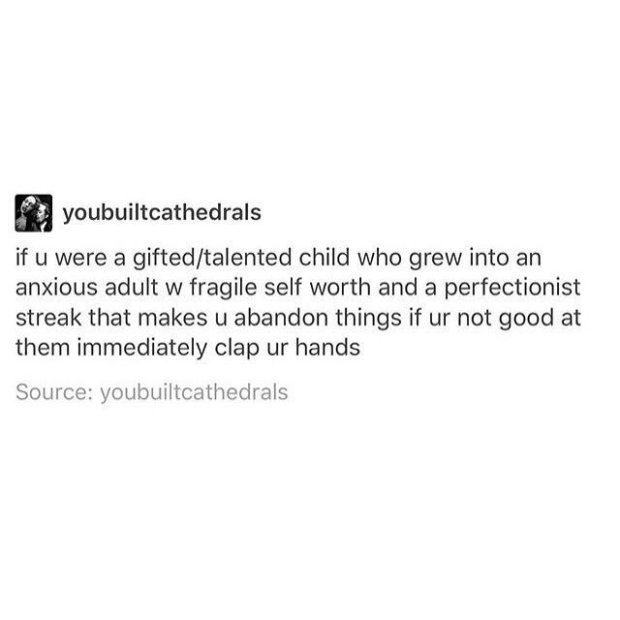
The next few months are probably going to be the hardest thing I’ve done. Maybe even harder than GCSE maths. And it’s all because, not to brag here, but I’ve never really failed before. While scrolling through Twitter on a clearly productive streak (…) I stumbled across a tweet that made me genuinely laugh out loud and give myself a reality check:

C9krZUQXkAUGHEj.jpg-large

It made me realise how stupid I was being. Like most ‘snowflake’, millennial graduates, I’d been told I was clever and capable my entire life. I got the highest grades, was put into the Oxbridge group in Sixth Form, and accepted into my dream university. Of course, this only happened with a ridiculous amount of hard work and hours pouring over textbooks, but it convinced me that if I worked hard, I could get exactly what I wanted. This, I quickly realised, is not the case, hence my Tesco breakdown.

So I’ve decided to use this year as a time to learn something new – cue swelling, inspirational music. Namely, how to fail. I’m sure plenty more rejections are coming my way, but that doesn’t mean my future is void of opportunities. I may not have skipped straight into a grad job, but I’ve managed to gain things I never thought I would. I’m starting a new (temporary) position at Mind, something I’ve wanted to do for ages. I’m about to get paid for my first published article and have just sent off another. In a few months, I’ll be spending a fortnight at The Times.

I may not be raking in the cash just yet, and the Dress of Dreams™ might have to wait for now, but it doesn’t mean I have nothing to look forward to. It certainly doesn’t warrant a public breakdown in a supermarket. What I’ve quickly come to realise, is that failing is ok. You don’t have to hide it, or construct elaborate lies to disguise it. Those who you really want in your life will support you, instead of gloating over your unemployment. And as for the other people? Screw them.

The Pointlessness of University Careers Fairs

With the second year of my degree comes the pressure to start making decisions about my future career. After a matter of days of being back on campus, I was inundated with emails inviting me to the various careers fairs organised very helpfully by the University on behalf of their promising students. My friend has written her own response for our student newspaper, which you can check out here

I never really knew (and still don’t) what I wanted to be when I grew up. There were so many options: author, actress, police woman, editor, neurologist, detective, journalist, marine biologist – these being just some of the many careers I’ve daydreamed about throughout my life. And so when it came to choosing my degree, I went with what I was best at and enjoyed the most – English. An arts degree, I thought, would give me a wide range of careers options for the future, despite the wincing looks and comments of “Not very practical, is it?” I got – and still get – from people when I told them what I would be studying.

However, from what my friends and I found at the careers fairs, I seem to have been sadly wrong about this. I decided to really get my act together this year and to start thinking seriously about my options for the future, rather than daydreaming about accepting my Oscar or becoming a world-renowned, risk-taking journalist. So my friends and I made the journey from our student house onto campus, where we were ushered into a conference room filled with an array of stalls representing different companies and organisations, like a really dull fairground for ambitious people.

But after circling the room, we soon found that the only stalls directed
at English students were companies offering teaching experience or law, echoing that one question that haunts those studying my degree: “So, you want to become a teacher?”

tumblr_ms9yaeS0sZ1qh12lfo1_r1_500

The dichotomy between arts/humanities students and science students is apparent at most universities, often coming in the form of teasing that those studying for a BSc are doing the “real” degree. Whilst this is mostly lighthearted (apart from when arguments about buying books ensue), it was discouraging to see that this attitude has leaked into the more serious world of careers, and though there was plenty on offer for those interested in law firms, banking or teaching, the whole fair seemed pointless for anyone studying for an arts degree, so much so that my friend wrote an article about it in our student paper.

My university is  currently in the top ten for English Literature in the UK, so it seems odd that the careers fair didn’t reflect the various and diverse careers available in the subject after graduating. I know my degree isn’t as “practical” as those which point to a particular career path, such as Law or Medicine, but this isn’t a good enough reason for the under-representation of arts-related careers. I would be wrong to say that arts degrees were the only ones under represented – those wishing to go into the field of scientific research would also have found next to nothing on offer.

If we want young people to think seriously about their careers options and ensure they find employment or an alternative such as further study, we need to ensure that they are exposed to a wide and unbiased range of possibilities. In 2014, The Independent stated that there were 18,000 graduates still unemployed six months after finishing their degree and from the limited choices available at the careers fair, I’m starting to see why.

Consider this a call to all universities to expose all of your students to as many career opportunities as possible. We are the future, after all.

What I Wish I Knew Before Starting University

About this time last year I was busy stocking up on cardboard boxes, books and enough tinned food to keep me from starving if the apocalypse occurred. And this was all because I would be starting my first year at uni on September 29th. Although this year has hands down been the best year of my life, and I wouldn’t change a single bit of it, here are some things I wish I’d known…

  1. If you’re living in halls, don’t bring a year’s supply of cleaning equipment. Due to my mother’s unhealthy obsession with wiping down every visible surface with bleach on a daily basis, she was adamant that I left for uni with two industrial sized bottles of Domestos, which just sat in the cupboard under my sink, untouched for three terms. If you’re living in halls, it’s very likely that you’ll have a cleaner who will clean your kitchen and bathroom. All you have to worry about is picking your hair out of the sink so it doesn’t get clogged (don’t wait until the water isn’t going down to do this) and making sure that last night’s rice doesn’t become a permanent presence on your saucepan.
  2. Make notes for your seminars. For some reason, I thought that as soon as I started university I’d morph inUntitledto a red wine-swirling, polo-neck wearing genius with opinions on everything and the ability to understand any book I read. This was not so. Although lectures seriously help with understanding the book, or subject you’re studying, tutors expect a little more from you in seminars. If they’re emailing you questions to think about, it’s important to actually go ahead and research them instead of just giving them a quick browse ten minutes before you leave for the seminar-otherwise you’re just left opening and closing your mouth in confusing, resembling a goldfish with flicked eyeliner.

  3. Read the books. I was pretty attentive with my reading and made sure it was completed every week, even if it meant staying up until four in the morning to finish Book Twelve of The Odyssey because I’d decided that watching Orange is the New Black was a higher priority that day. The one time I decided not to read on of the books for my modules, only one other person turned up to the seminar-and he hadn’t read the book either. Luckily my tutor hadn’t been in the lecture so I was able to spiel off a lot of things about the apocalypse and impotence, which seemed to go down well.
  4. It’s not compulsory to go out drinking on Fresher’s. Drinking was never my thing, and drunk people just outright annoyed me, so why I thought I’d suddenly find both of these things ‘fun’ when I came to uni is a mystery. On my first night in halls, I decided to go to the ‘party’ in the flat below, wmarlborohich basically consisted of a topless, stoned version of Jack Whitehall who kept showing me the ashtray he got from his ‘lads holiday’ in Amsterdam, and three other girls smoking Marlboros out of a kitchen window and doing shots of pink absinthe. Even though I kept telling myself that this was the “uni experience”,I was back in my room by 1 AM. While I had been running around throwing shots over my shoulder and pretending to be having a good time, my best friend had been tucked up in bed watching Bake Off, which was much more my cup of tea. Basically, there’ll always be someone who’s not up to drinking to hang out with.

  5. Get involved in societies. The one thing I wish I had done this year was to join more societies. I saw university as a fresh start, and before going decided I’d join EVERYTHING – the newspaper, dance, the drama society, the feminist society, athletics. I actually didn’t join any of these, and instead wandered around the societies fair with a few flatmates, only picking up leaflets for the societies they were interested in, just in case they thought I was a massive loser for playing the violin. Societies are a great way of making friends, simply because you’ve already established that you have a common interest. Also, societies often offer exec positions, which look great on a CV.
  6. You’re probably not going to be best friends with your flatmates. Before I moved in, I had visions of my flatmates being the cast of F.R.IE.N.D.S and uni life being like one long episode, minus the canned laughter. In actual fact, most of my flatmates didn’t leave their rooms unless they really had to, and I only properly made frends with one boy out of the thirteen people I lived with. But being friends with your flatmates isn’t the be-all and end-all of your social life. Everyone on my course was super friendly and made an effort to talk to people, and your circle expands through the societies you join and mutual friends of other people. On the other hand, I know plenty of people who are best friends with their flatmates. It can go either way.
  7. Before you fork out £50 on the best dictaphone in PC World, check the university’s policy on recording lectures. I suffered from serious second-hand embarrassment when one of my lectures was stopped for our professor to remind a boy, in front of 200 people, that the university didn’t allow students to record their staff.
  8. Bring ear-plugs and headphones. Being kept up by Estelle’s ‘American Boy’ being blasted at three in the morning tends to happen more often than you’d think. Also, as good as you think your music taste is, the girl below you probably doesn’t want to listen to it through her ceiling.
  9. Get a provisional license even if you can’t drive. Carrying passports around on a night out is a real pain.
  10. The ‘fresher’s 15’ is not a myth. My friend from home remarke that a lot of people from my Sixth Form had come back from uni a lot wider than they used to be (and I couldn’t help feeling that I was included in this). Oven chips on a daily basis may seem like a good idea, but your body won’t thank you for it.
  11. Neither is fresher’s flu – no one is safe, no matter how strong your immune system. Stock up on Ibuprofen and always paracet.bring water to lectures. There’s nothing worse than something coughing though a lecture except being the person coughing through a lecture.
  12. You’re going to be a little fish in a big pond again, but that’s just going to prepare you for life. You may have been the genius in your little village secondary school, but you can bet everyone else on your course was too. Once you accept that your self-validation can no longer come from getting the best grades, you’ll start to develop more as a person and learn to value yourself in new ways – as soppy as that sounds.
  13. Grease Lightening is the best song for getting creeps away at night clubs. Nothing says “stop invading my personal space” better than not-so-accidentally punching someone during your enthusiastic dancing.
  14. Even though “first year doesn’t count” is basically the fresher’s mantra; you still need to work hard. Getting essays done on time, attending lectures and revising in time for end of year exams will all help you avoid having a meltdown on the phone to your mum.
  15. Double save everything. A friend of mine had a terrible experience of writing a 3000 word essay, only for her laptop to completely die the night before it was due. Memory sticks save lives.
  16. Be yourself. University is a fresh start. You’re no longer with people who’ve seen you during your awkward emo years or when you had that terrible haircut in Year 8. You won’t be branded a ‘loser’ for playing in an orchestra, or enjoying musical theatre, or writing anymore because there are hundreds of other ‘Yous’ out there who enjoy doing those same things. If there’s one thing I’ve learnt from my first year at uni, it’s that it’s the one place where I can be unashamedly myself and my confidence has rocketed.

Wherever you’re going to university, I hope you have the best time – I wouldn’t change anything about my experience.